


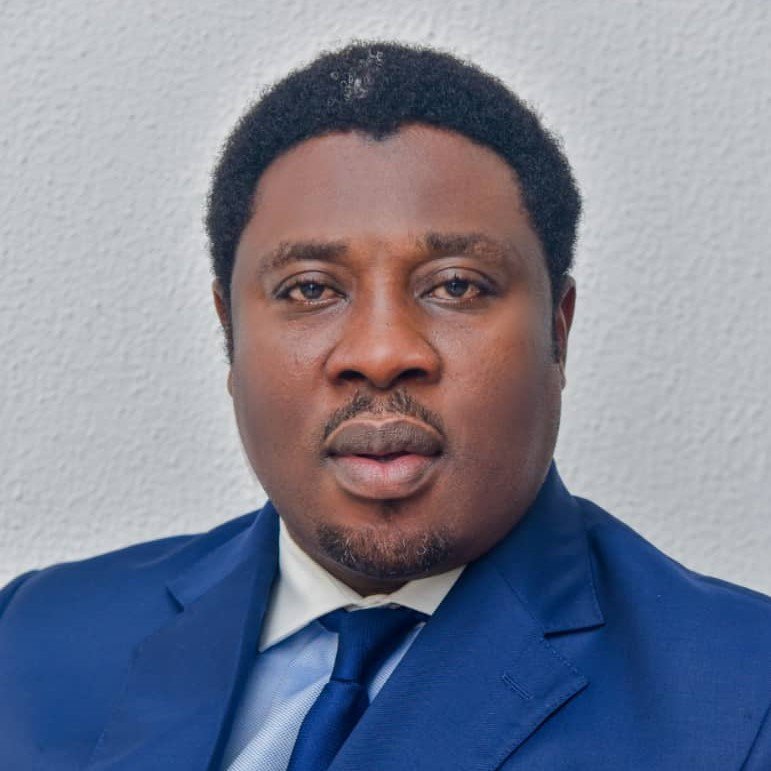
• Ambassador Kunle Yusuff (MON)
The Director-General of the Civil Society Organisations on Community Advancement and Humanitarian Empowerment Initiative (CSCHEI) and National Convener of the National Civil Society Organisations Summit 2026, Amb. Kunle Yusuff, (MON), has said civil society is not anti-government but pro-Nigeria.
He emphasised that it must be recognised as an indispensable partner in nation-building.
Yusuf declared this while delivering his keynote address at the National Civil Society Organisations Summit 2026, held at the Bola Ahmed Tinubu International Conference Centre under the theme: NIGERIA FIRST.
The summit was declared open by Secretary to the Government of the Federation, Senator George Akume, on behalf of President Bola Tinubu.
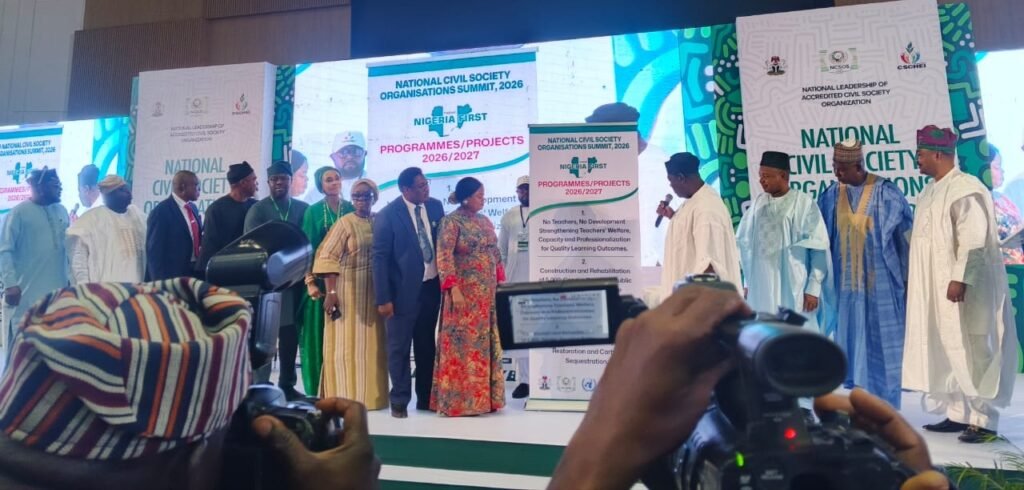
Addressing President Tinubu, the leadership of the National Assembly, ministers, members of the diplomatic corps, traditional rulers, and civil society leaders drawn from the 36 states and the Federal Capital Territory (FCT), Yusuff stated that he stood before the gathering not only as a convener but as a witness to sacrifice.
He revealed that over the last four years, civil society groups have invested collective resources to keep the voice of the Nigerian people alive.
He added that the summit reaffirmed the credibility of accredited civil society organisations in Nigeria, despite considerable operational challenges, including extensive travel and documentation over the past six months.
According to him, the summit is anchored on the simple philosophy of Nigeria First.
”When we put Nigeria first, ethnicity disappears. When we put Nigeria first, religion becomes a bridge, not a barrier. When we put Nigeria first, civil society ceases to be a mere critic and becomes a partner in nation-building,” he said.
Yusuff expressed concern that the summit came at a critical juncture when unpatriotic and self-centered interests are propagating divisive narratives for political gain, placing the nation at a crossroads.
He explained that deliberations at the summit were structured around four strategic pillars designed to define Nigeria’s future, which are: Civic Education, Electoral Integrity, and Peaceful Elections; Sustainable Development, Food Security, and Climate Finance; Security, Peace, Democratic Governance, and the Rule of Law; and Information Integrity, Strategic Communication, and Digital Governance
On electoral integrity, Yusuff stressed that without credible elections, legitimate governance could not exist. He directed the message to the Independent National Electoral Commission (INEC), security agencies, and civil society organisations, serving as accredited election observers.
”A hungry nation cannot be a peaceful nation; sustainable development cannot thrive in an environment of instability; and in an age of disinformation, truth is a national security asset,” he stressed.
Providing empirical data on the civil society sector, the convener disclosed that Nigeria has over 65,000 registered Civil Society and Community-Based Organisations (CSOs/CBOs), out of which approximately 25,000 are active.
He explained that records indicated 17,000 are working with various government agencies, 7,250 are institutional associates of CSCHEI, and 3,750 accredited CSOs and CBOs are operationally active across 485 local government areas in 26 states.
”We are the bridge between policy and the people. For too long, policies have been formulated for the people without the presence of the people. This must change,” he declared.
Yusuff announced three major outcomes expected from the summi, which include The Abuja Declaration on Nigeria First. It has to do with a citizen-driven charter defining collective commitment to national unity and productivity.
The second thing he mentioned is the National CSOs Monitoring Framework, which is a platform to transparently track public budgets, electoral promises, and climate funds.
He added that an agreement for civil society, government, and the private sector to operate in synergy and mutual trust as the third focus.
Describing the outcomes as civil society’s contribution to the administration’s Renewed Hope Agenda, he noted: “We are not here to complain; we are here to make positive contributions.”
While commending civil society leaders, who traveled from across the country with their Corporate Affairs Commission (CAC) certificates out of faith in the Nigeria First vision, he called on public officials to invite civil society to the decision-making table.
”We have data from the grassroots. We have early warning systems. We have strategic recommendations for sustainable solutions,” he added
He appealed to private enterprise and privileged individuals to support the movement.
Yusuff appreciated President Tinubu for acting on three out of nine critical issues previously presented during a delegation visit to the State House, particularly highlighting the declaration of a state of emergency on poverty and the consideration to expend N150billion on social protection.
He further praised the President for appointing Ambassador Kayode Aare as Nigeria’s Ambassador to the United States and Ambassador (Senator) Jimoh Ibrahim (CFR), as Permanent Representative to the United Nations, noting their efforts in restoring Nigeria’s global image.
He recalled that at the recently concluded United Nations General Assembly (UNGA), Nigerian CSOs were granted approval to co-sponsor the UNGA High-Level Global Executive Roundtable Side Event 2026 at UN Headquarters (Conference Room 11) through the Permanent Mission of Nigeria in New York, supported by the United Nations Institute for Training and Research (UNITAR).
He added that Ambassador Aare actively engaged civil society representatives and presented key development documents highlighting Nigeria’s potential.
Yusuff stressed that the leadership of accredited CSOs under CSCHEI operates strictly on principles of logic, science, and data, with an ideology rooted in meritocracy, pragmatism, and honesty.
He charged all stakeholders to play their part in ensuring INEC conducts a credible, peaceful, free, and fair general election in 2027.
Dignitaries present at the event also included Minister of Budget and Economic Planning, Senator Abubakar Atiku Bagudu; Senior Special Assistant to the President on SDGs, Princess Adejoke Orelope-Adefulire (OFR); Chairman of the African Civil Society Forum, Prof. Tunji Asaolu; State Coordinators of CSOs; and former Vice-Chancellor of Fountain University, Prof. Amidu Sanni.